

Joni Eareckson Tada, paralyzed since a diving accident when she was seventeen (she is now 75), was speaking to her husband’s high school government class about the implications of ‘right-to-die’ laws. She tells this story from the discussion that day in her book When is it Right to Die? (1992, updated 2018).
———————————
I was surprised by how interested they were as I divulged my despair of earlier days. I admitted my relief that no right-to-die law existed when I was in the hospital and hooked up to machines. I then underscored how critical it was for every student to become informed and involved in shaping society’s response to the problem. Then I added, “What role do you think society should play in helping people decide when it is right to die?”
A few hands went up. I could tell by their answers that they felt society should take action to help hurting and dying people— some students insisting on life no matter how burdensome the treatment, and a few wanting to help by hurrying along the death process.
One student shared how his mother was getting demoralized by the burden of taking care of his sister with developmental delays. He felt society should, in his words, “do something.”
“Like what?” I playfully challenged.
“Like . . . I’m not sure, but society ought to get more involved in the lives of people like my mother.”
I then asked him, “May I ask what you have done to get more involved?”
The student smiled and shrugged.
“How have you helped alleviate the burden? Have you taken your sister on an outing lately? Maybe to the beach?” I teased. “Have you offered to do some shopping for your mother? Maybe your mom wouldn’t be so demoralized, maybe she wouldn’t feel so stressed or burdened, if you rolled up your sleeves a little higher to help.”
A couple of his friends laughed and threw wads of paper at him. “Okay, okay, I see your point,” he chuckled.
I smiled. “My point is this: Society is not a bunch of people way out there who sit around big tables and think up political trends or cultural drifts; society is you. Your actions, your decisions, matter. What you do or don’t do has a ripple effect on everyone around you. And on a smaller scale, your participation can even make a huge difference in what your family decides to do with your sister.”
The classroom fell silent, and I knew the lesson was being driven home. I paused, scanned the face of each student, and closed by saying, “You, my friends, are society.”
————————————–
ANOTHER STORY (source lost):
One day, I saw an old man on a sidewalk bench, cold and shivering in a thin coat, with little hope of a decent meal. I became angry and I said to God: ‘Why do you permit this; and why don’t you do something about it?’ For a while, God said nothing. Then, quite suddenly, God interrupted my thoughts with his reply saying, ‘I certainly did do something about it. I made you, and I put that old man right there in front of you today. Why didn’t you do something about it? You could have least bought him a sandwich and a cup of warm coffee. You could even have given him your coat. He was about your size and you have six more coats in your closet at home. I have never seen you wear all six at once. I have blessed you with far more than you need. Why didn’t you do something?’
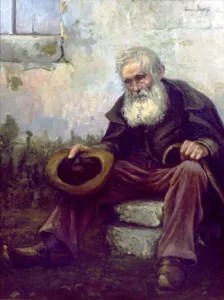
You might not very often be faced with a situation like that, but there are, as you well know, many people like that old man who are in desperate need of food and a warm place to stay. Helping is usually more complicated than giving someone a sandwich or the coat off your back, but there are many organizations that have figured out how to do that really well, for many people, every day, year-round. The Salvation Army is one of the best, and local food shelves also are a life-saver for many people in your own community. Throughout the pages of the Bible, God commands us to share what we have been given to feed the hungry. If you are not already doing so, decide now to contribute regularly to the Lord’s work in this way.
Matthew 25:34-40 — (Jesus said), “The King will say to those on his right, ‘Come, you who are blessed by my Father; take your inheritance, the kingdom prepared for you since the creation of the world. For I was hungry and you gave me something to eat, I was thirsty and you gave me something to drink, I was a stranger and you invited me in, I needed clothes and you clothed me, I was sick and you looked after me, I was in prison and you came to visit me.’
“Then the righteous will answer him, ‘Lord, when did we see you hungry and feed you, or thirsty and give you something to drink? When did we see you a stranger and invite you in, or needing clothes and clothe you? When did we see you sick or in prison and go to visit you?’
“The King will reply, ‘Truly I tell you, whatever you did for one of the least of these brothers and sisters of mine, you did for me.’”
Galatians 5:13 — You were called to be free. But do not use your freedom to indulge the flesh; rather, serve one another in love.
Mark 9:41 — (Jesus said), “Truly I tell you, anyone who gives you a cup of water in my name because you belong to the Messiah will certainly not lose their reward.”
Deuteronomy 16:17 — Each of you shall give as you are able, bringing a gift in proportion to the way the Lord your God has blessed you.
*********************************************
You are never tired, O Lord, of doing us good; let us never be weary of doing you service. But as you have pleasure in the well-being of your servants, let us take pleasure in the service of our Lord, and abound in your work and in your love and praise evermore. Amen. –John Wesley
Related Posts


