

“Science Increasingly Makes the Case for God”; an article by Eric Metaxas , December 25, 2014, Wall Street Journal
——————————————–
In 1966 Time magazine ran a cover story asking: “Is God Dead?” Many have accepted the cultural narrative that He’s obsolete—that as science progresses, there is less need for a “God” to explain the universe. Yet it turns out that the rumors of God’s death were premature. More amazing is that the relatively recent case for his existence comes from a surprising place—science itself.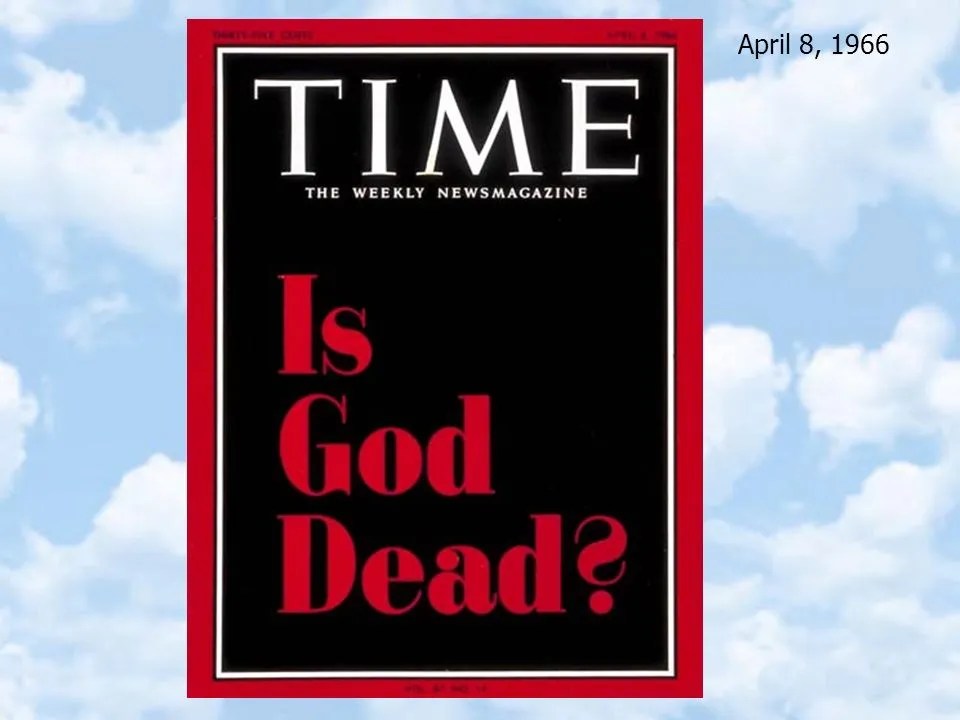
Here’s the story: The same year Time featured the now-famous headline, the astronomer Carl Sagan announced that there were two important criteria for a planet to support life: The right kind of star, and a planet the right distance from that star. Given the roughly octillion—1 followed by 27 zeros—planets in the universe, there should have been about septillion—1 followed by 24 zeros—planets capable of supporting life.
With such spectacular odds, the Search for Extraterrestrial Intelligence, a large, expensive collection of private and publicly funded projects launched in the 1960s, was sure to turn up something soon. Scientists listened with a vast radio telescopic network (see photo below) for signals that resembled coded intelligence and were not merely random. But as years passed, the silence from the rest of the universe was deafening. Congress defunded SETI in 1993, but the search continues with private funds. As of 2014, researchers have discovered precisely NOTHING.
What happened? As our knowledge of the universe increased, it became clear that there were far more factors necessary for life than Sagan supposed. His two parameters grew to 10 and then 20 and then 50, and so the number of potentially life-supporting planets decreased accordingly. The number dropped to a few thousand planets and kept on plummeting.
Even SETI proponents acknowledged the problem. Peter Schenkel wrote in a 2006 piece for Skeptical Inquirer magazine: “In light of new findings and insights, it seems appropriate to put excessive euphoria to rest. We should quietly admit that the early estimate may no longer be tenable.”
As factors continued to be discovered, the number of possible planets hit zero, and kept going. In other words, the odds turned against any planet in the universe supporting life, including this one. Probability said that even we shouldn’t be here.
Today there are more than 200 known parameters necessary for a planet to support life —every single one of which must be perfectly met, or the whole thing falls apart. For just one example, without a massive planet like Jupiter nearby, whose gravity will draw away asteroids, a thousand times as many would hit Earth’s surface. The odds against life in the universe are simply astonishing.
Yet here we are, not only existing, but talking about existing. What can account for it? Can every one of those many parameters have been perfect by accident? At what point is it fair to admit that science suggests that we cannot be the result of random forces? Doesn’t assuming that an intelligence created these perfect conditions require far less faith than believing that a life-sustaining Earth just happened to beat the inconceivable odds to come into being?
There’s more. The fine-tuning necessary for life to exist on a planet is nothing compared with the fine-tuning required for the universe to exist at all. For example, astrophysicists now know that the values of the four fundamental forces—gravity, the electromagnetic force, and the “strong” and “weak” nuclear forces—were determined less than one millionth of a second after the big bang. Alter any one value and the universe could not exist. For instance, if the ratio between the nuclear strong force and the electromagnetic force had been off by the tiniest fraction of the tiniest fraction—by even one part in 100,000,000,000,000,000—then no stars could have ever formed at all. Feel free to gulp.
Multiply that single parameter by all the other necessary conditions, and the odds against the universe existing are so heart-stoppingly astronomical that the notion that it all “just happened” defies common sense. It would be like tossing a coin and having it come up heads 10 quintillion times in a row. Really?
Fred Hoyle, the astronomer who coined the term “big bang,” said that his atheism was “greatly shaken” at these developments. He later wrote that “a common-sense interpretation of the facts suggests that a super-intellect has monkeyed with the physics, as well as with chemistry and biology. The numbers that one calculates from the facts seem to me so overwhelming as to put this conclusion almost beyond question.”
Theoretical physicist Paul Davies has said that “the appearance of design is overwhelming” and Oxford professor Dr. John Lennox has said “the more we get to know about our universe, the more the hypothesis that there is a Creator gains in credibility as the best explanation of why we are here.”
The greatest miracle of all time, without any close seconds, is the universe. It is the miracle of all miracles, one that ineluctably points with the combined brightness of every star to something—or Someone—beyond itself.
——-
(2026 update: Now, after over 60 years of searching, the Search for Extraterrestrial Intelligence (SETI) still has not found any confirmed evidence of alien intelligence. Despite scanning billions of radio sources and analyzing massive datasets—including 950 million objects and 12 billion signals, no artificial signals have been detected.)
————————————
Eric Metaxas wrote this article as an op-ed piece to publicize his latest book at the time “Miracles: What They Are, Why They Happen, and How They Can Change Your Life” (2014). This article quickly went on to garner over 600,000 Facebook shares and more than 9,250 comments, making it unofficially the most popular article the Wall Street Journal history.
The article briefly introduced the subject of just one chapter in the 2014 book. In 2021 Metaxas published Is Atheism Dead? (title counters the 1966 Time article title). There you may find 432 pages more on the scientific case for God as creator of the universe. It is a fascinating read.
In the twelve years since the above article, science has made many more discoveries which make it even more difficult to believe that this whole universe and everything in it just got here all by itself. For the “God is dead” believers, the case for their argument becomes more and more implausible, while the case for the Genesis creation account keeps getting stronger.
Eric Metaxas in the introduction to Is Atheism Dead?, commenting on the record-breaking response to the Wall Street Journal article, wrote:
People were hungry for answers to the Big Questions, such as whether there is a God, and if we can know about that rationally. And of course, everyone wanted to know what science had to say about all of this. But because we live in a world that generally avoids such questions, we rarely hear these things discussed in any public forum. Good answers therefore, elude us, which we can find frustrating. So, when this essay appeared, was it any wonder so many readers responded as they did? Finally, they were getting some answers for these questions no one ever seemed to talk about. And these answers were the very opposite of what the general cultural conversation had led them to believe. (and, the answers were solidly based on science!)
For those interested in more, SEE ALSO: This article and this article and this article and this article and this article and this article.
****************************************
Genesis 1:1 — In the beginning God created the heavens and the earth.
Psalm 19:1 — The heavens declare the glory of God, and the firmament shows forth His handiwork.
Psalm 33:6…9 — By the word of the Lord the heavens were made, their starry host by the breath of his mouth… For he spoke, and it came to be; he commanded, and it stood firm.
Hebrews 11:3 — By faith we understand that the universe was formed at God’s command, so that what is seen was not made out of what was visible.
Romans 1:20 — For since the creation of the world God’s invisible qualities—his eternal power and divine nature—have been clearly seen, being understood from what has been made, so that people are without excuse.
****************************************
O God, we thank thee for this universe, our great home; for its vastness and its richness; and for the life which moves upon it and of which we are a part. We praise thee for the arching sky and the blessed winds, for the driving clouds and the constellations on high. We praise thee for the salt sea and the running fresh waters, for the everlasting hills, for the trees, and for the grass under our feet. We thank thee for our senses by which we can see the splendor of the morning, hear the jubilant songs of the birds, and smell the breath of the springtime. Grant us, we pray, a heart wide open to all this joy and beauty, and save our souls from being so steeped in care and so darkened by discontent that we pass heedless and unseeing, when even the thorn-bush by the wayside is aflame with the glory of God. Amen.
–Walter Rauschenbusch (1861-1918)
****************************************
For those who may be interested in much more, here are two videos of Eric Metaxas talking about this book. The first is five minutes long, the second in 52 minutes long (you may skip the first four minutes):
Related Posts


